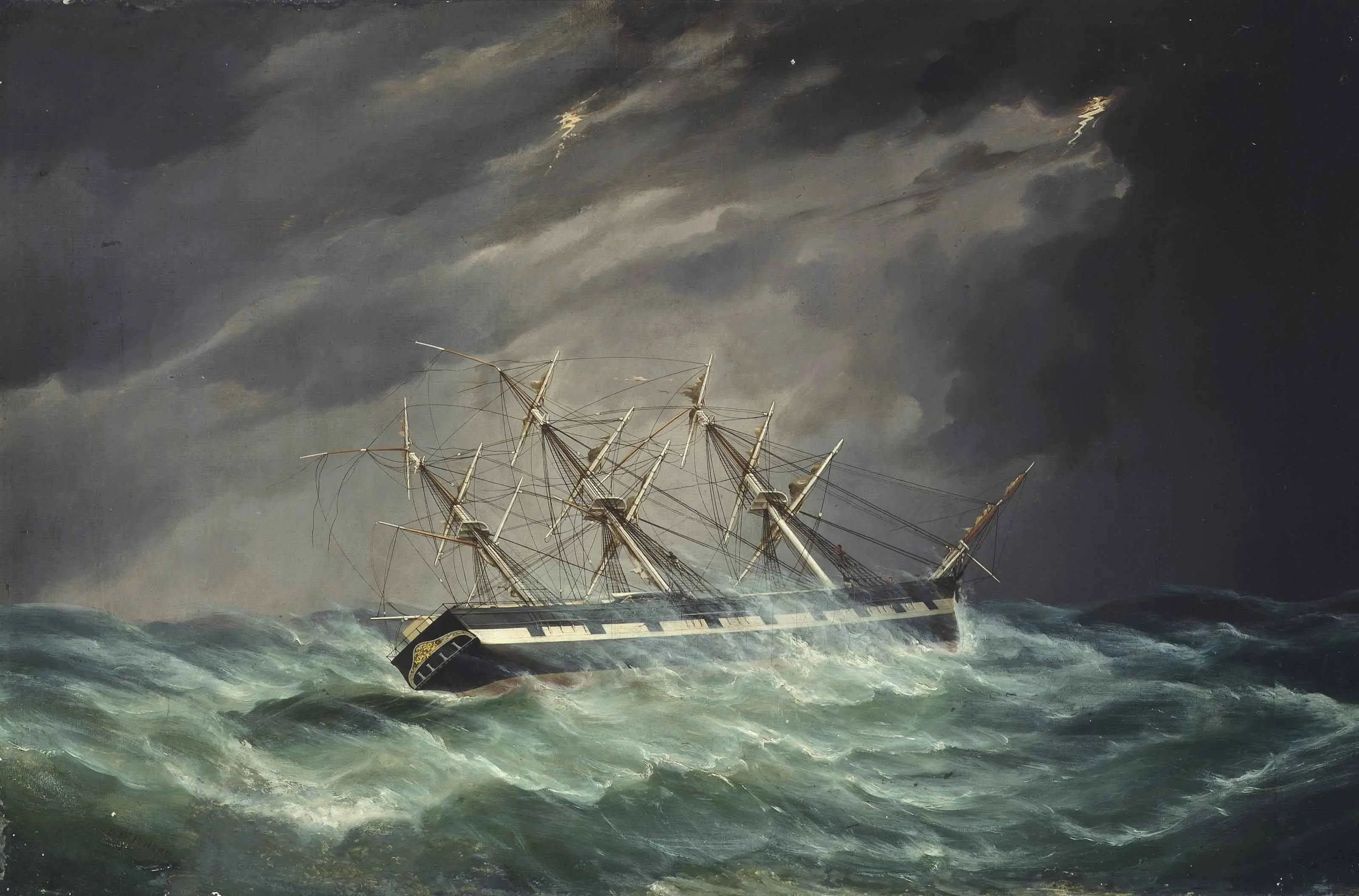
On June 28, 1839, the first group of Lutherans boarded small ships and sailed to the east coast of England. They then traveled across England to Liverpool, where they boarded large sailing ships for the trip to New York.
The Lutherans in Grabau’s congregation who wished to emigrate came to America on the five ships. This large transport is put at 1,000 individuals by several sources. But in fact it was considerably larger, even without the contingent that had arrived earlier. Whereas the earlier group traveled directly from Hamburg to New York, the next five ships went via Liverpool, as von Rohr had arranged. Liverpool was the meeting point. Up until there they traveled separately on different routes, about 600 via Newcastle upon Tyne and about 400 via Hull. They all traveled to these port cities by steamer. They departed from Hamburg on five ships, the first on Friday, June 28 at 2 p.m., the second and third two days later, the fourth on July 12 and the fifth on July 27. Since they also continued the transatlantic journey on five ships, it is likely that the distribution of the passengers remained the same from Hamburg on. Grabau traveled on the last ship, and rightly so, to oversee the transport of his people.
Of the groups sailing via Hull we know only that they went to Liverpool on cross-channel boats. But we are better informed on the groups that sailed via Newcastle, thanks to two sources. Following the passage of these Lutheran emigrants through England, the publishing company of Hamilton, Adams & Co. brought out a small book in 1840 entitled The Persecution of the Lutheran Church in Prussia. Here we are interested only in the preface, which was signed “A.H.R.” on December 26, 1839, in Newcastle. It read:
“In the summer of 1839, a company of interesting strangers in German clothing were observed entering the harbor at Newcastle on Tyne. They stayed only a few hours there and traveled on to Liverpool, from which point they intended to sail to America. Inquiries were made by representatives of the Bible Society as to whether they needed Bibles, and they received a pleasing response.
“Their conduct was polite. But they seemed to have no letters of recommendation to anyone in this region. Little could be learned of their story, except that they were Lutheran emigrants who were going to uncivilized America due to severe religious persecution in their native country.
“One or two weeks later, a similar company arrived, and others gradually followed throughout the summer months, about 600 individuals in all… They showed no bitterness toward their oppressors, nor did they grumble. But the sickly appearance of many, the gray hairs of respectable people and the streaming tears of the women showed clearly enough that this was not brought about by any ordinary circumstances. They were seen praying at evening.
“Only a few were from higher classes, most of them were apparently peasants and laborers. The visitors could only offer small sums of money, but these were always accepted with the deepest gratitude. Each company had common funds. If asked whether they were angry with their government, they answered that they were not. Once some young people even said that they would all give their lives for their king.
“Are these people whom one drives out of the country? If their own country disowns them, surely the hearts of British Christians will protest against such cruel treatment and seek to alleviate their suffering…
“The people of this region showed great interest in the admittance of 400 Tyrolians by the King of Prussia. But this is not consistent with the persecution of thousands of his own subjects, simply because they do not wish to unite with the state church.”
This preface is followed by a request for donations for the emigrants, to be paid to a committee via the Union Joint Stock Bank or Barnett, Hoare & Co., bankers in London. There is also mention of the fact that a number of letters from Grabau have been received in Newcastle since his short stay in the city. We hear that Grabau received a sum of money from Newcastle in America. The second source is Ernst Schmidt’s letter, which we mentioned earlier. It read:
“We departed with the help of God on July 28, 1839, but had to lay anchor at Cuxhaven already due to unfavorable winds. After that, though, we continued the voyage. We were onboard a steamer. The storm persisted, and all but a few were overcome with seasickness. And then there was the pounding of the engine, the grease from the machinery and the steam from the coals. The storm was against us, but we fortunately reached England at Newcastle — 130 miles in 36 hours.
“The people are very friendly. They gave us shelter for the night, coal and $62, along with a packet of English Bibles. We continued by steam locomotive — 15 English miles in three hours. Words cannot express what a machine that is and how well it runs. It is more than majestic, and such a relief after the seasickness… On the southern border of Scotland and in northern England we traveled by channel, whereby the boat was pulled by two horses. Then we boarded a steamer. In 24 hours we were in Liverpool. Here we had to wait nine days. Here I had to deal with much difficulty, particularly with cooking for my family. Our dear Pastor Grabau held a public worship service in Liverpool on the ship’s deck. It did not remain a secret, why we left Prussia.”
Iwan continues the story: From Liverpool the Lutherans crossed the ocean in five American sailing ships. The first four ships were called “Georgina,” “Alfred,” “Republic” and “Britannia.” We hear little of their voyage. The passengers arrived in New York happy and had good provisions on the ship — water and healthy food, a quarter pint of brandy per day for those peasants accustomed to it, fresh milk for the women and children, wine, refreshments and medicine for the sick. Still, two people assigned to these ships died, both of them among the congregation’s elected deputies. Wilhelm Bortfeld died already in Hamburg, and David Helm of Scharchow died at sea.
These four ships all arrived in New York between September 4 and September 10, 1839. There they were accommodated on board ships at reasonable prices until it could finally be decided where they should go. This decision was not to be made until Grabau, who was on the fifth ship, arrived. This ship’s arrival, however, took some time, and rumors spread that it had met a fate similar to that of the fifth of Stephan’s ships, which had sunk the year before, taking everyone with it.
But to the relief of all, Grabau’s ship finally arrived in New York on September 18. It had sailed from Liverpool on August 14 and had a terrible journey. Again, Ernst Schmidt describes it for us:
“Our ship set out to sea after nine days in Liverpool. We were surrounded by crowds of people. It was a new, five-year-old, very spacious ship with three masts. It was carrying salt. In addition, there were 220 Lutherans (from Thuringia, Saxony, Pomerania and Silesia), 20 sailors and another five passengers, totaling 245 individuals. The wind was favorable. The ship passed between Ireland and Scotland. The wind became increasingly stronger and better, so that we managed to cover 250 German miles in three days.
“Then seasickness returned. Brother Reimann and his son were not at all sick, whereas his wife was hardly well for four weeks, as was brother Schulthes. I was sick for ten days, after which time I became accustomed to the tossing of the ship. But then the wind became unfavorable, so we had to tack. Two storms came but did no damage.
“Then we saw a night in which not a single wave could be seen in the ocean. The journey proceeded quickly. Pastor Grabau held devotions on deck every evening. Life on the ship was blissful. Everyone was cheerful and invigorated. My heart was full of praise and thanks. In the mornings an officer held the devotion. That was beautiful.
“It was then that the first passenger died on the ship, a Pomeranian of 24 years. He was buried at sea the same day. Pastor Grabau conducted the burial ceremony. That was in the Spanish Sea, where it is so deep that no one can find the bottom. More became sick on the warm Gulf Stream, especially the Pomeranians. Two adults and three children died before we reached New York. On September 12, I told Pastor Grabau that no one needed to fear in such waters. I felt blissful. The pastor was silent. We held our evening prayers and laid ourselves down to sleep.
“At midnight the wind began to rage. The sailors wanted to furl the sails. The captain, a foolhardy man, did not permit that and continued until 3 o’clock with full sails. When the storm continued to grow, he ordered the sails to be taken in. The sailors had hardly climbed onto the masts when one was tossed into the sea and drowned. Another was caught in the sail and could not be rescued for two hours, and two fell down to the deck — fortunately without harm.
“Now the sails — 22 of them in all — had to be left exposed to the storm. They were brand new, having been bought just three weeks earlier in England. It was only then that the danger truly began. We were told to call on God, since we would be lost if he did not rescue the ship. Everyone cried to the Lord with all their strength, even the children and criminals. The ship tossed frighteningly. Death threatened to come any minute. All the barrels and crates, which had not been battened down, were flung from one corner to the other. All the vessels which were not well packed shattered. Part of the deck broke in the middle of the ship. Water was pouring into the ship. At times it came up to our knees. Amid this peril of death arose the cry that the ship was breaking. Everyone charged up the steps until they broke. I sat on my bed with my family, and we held each other as tight as we could. I asked the Lord whether I should also run on deck. I received the answer that I should remain calm.
“The brethren quickly came back and reported that the ship was not breaking. Brother Reimann went on deck to convince himself of the waves. He said he saw waves as tall as the Elisabeth Church in Breslau, and that the ship was in the depths one moment and atop a wave the next. All the sails were torn, two masts had broken at the top. The middle mast, which was the thickest, had broken in the middle. The sturdy crossbeams, to which the sails were attached, had broken in two. But through all this, the Lord was still with us on the ship.
“That afternoon the wind died. We had eaten nothing all day, and we could not cook because our two kitchens had been destroyed. September 13 will always be remembered by us and our children. The sailors were very capable. They mended 18 sails in two days, and our journey continued. By September 15 the sea had calmed down. It was still and smooth as a mirror. We had celebrated the third day of repentance when we sighted land. How happy we were, it was America. After a voyage of five weeks, we arrived in New York.”
Even before they reached New York, a son, Wilhelm, was born to the Schmids. But he soon died and was buried on land.
From a biography of Grabau written by his grandson, we learn that someone had ignored Grabau’s warning and given the second mate, along with several sailors, brandy, so that they were not equal to the danger when the hurricane broke loose. The captain, he adds, repeatedly said, “We can do nothing,” and locked himself in his cabin to await death. The ship was full of water, and all hope seemed lost. Then one of the Lutherans tasted the water, and lo and behold, it was freshwater. The storm had smashed the kegs containing freshwater. Thus the danger of the ship filling up was not so great. Pastor Grabau encouraged the frightened and desperate people. The water was pumped out, the sails were mended, and the ship was saved. On September 18 they landed at New York, and on September 20 the passengers disembarked.