The Emigration Story · Part IV of V
The Journey from New York to Milwaukee
The Rest of the Trip: The Erie Canal & Great Lakes
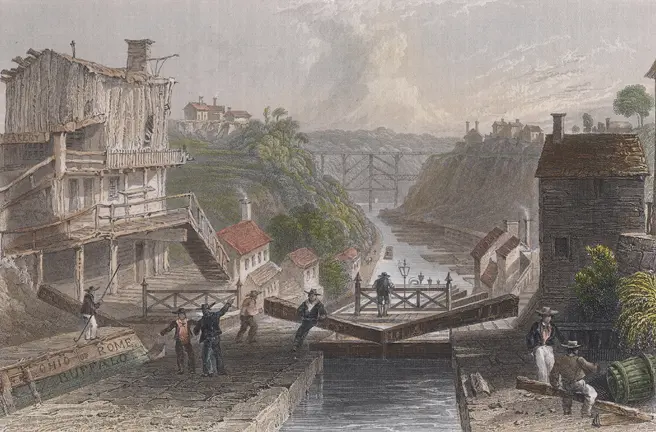
The first four ships made it to New York without problems, and they arrived by September 10. Because it was so late in the year, this group immediately made plans to continue the journey without waiting for the fifth ship with Pastor Grabau on board. It had been hit by a bad storm, and its whereabouts was unknown until it docked in New York on September 18, 1839, and on September 20 those passengers disembarked.
With this, all the Old Lutheran emigrants of 1839 were in America. Von Rohr had prepared this well. He stated that according to his information there were three possibilities. First, they could stay in New York and work on the canals. Or they could go to Buffalo, where Krause had already formed a small congregation with a few families, and where the Silesians under Bierosch had already gone. Then those without money could stay in Buffalo with one of the pastors and work on the Erie Canal until they earned enough to follow if they wished.
Those with money and the desire would then go on to Wisconsin, buy land at the government rates of $1.25 per acre, and found a settlement. Thus Buffalo and Wisconsin would be the two congregations where the Lutherans would concentrate their efforts and build a church and school. They hoped to unite with Pastor Krause’s congregation in Buffalo. Von Rohr immediately signed a contract with the shipping agent Wolff to transport 1,000 individuals, along with a hundredweight per person, by steamer to Albany and from there by canal boat to Buffalo. Once he had taken care of everything for Grabau’s arrival, he headed to Buffalo to prepare for the emigrants there. Von Rohr’s first task was to find lodging for the brethren, who would arrive soon. He rented a few warehouses in Buffalo to house the emigrants temporarily.
The trip to Buffalo was neither cheap nor pleasant, since the emigrants had a lot of excess freight with them — some as much as six to ten hundredweight instead of just one. The mass of crates cramped the space on the ship, and the captains took advantage of that to break the terms of the contract, despite the care taken in drawing it up. It is said that the emigrants suffered more during this six to eight-day voyage than on the ships at sea.
Once in Buffalo, the group held a congregational meeting. It was decided that elders should be elected by those staying in Buffalo and by those going on to Wisconsin. The elders should meet once each week. Schools should be started at once in Buffalo and Wisconsin, and since they had brought two organs, one would stay in Buffalo and one would go to Wisconsin.
These resolutions are clear proof of how pressing intellectual and spiritual nourishment was to the emigrants. Even when some of them were still sleeping on warehouse floors, and others were set to journey into the primeval forest, they were nonetheless making decisions about church and school.
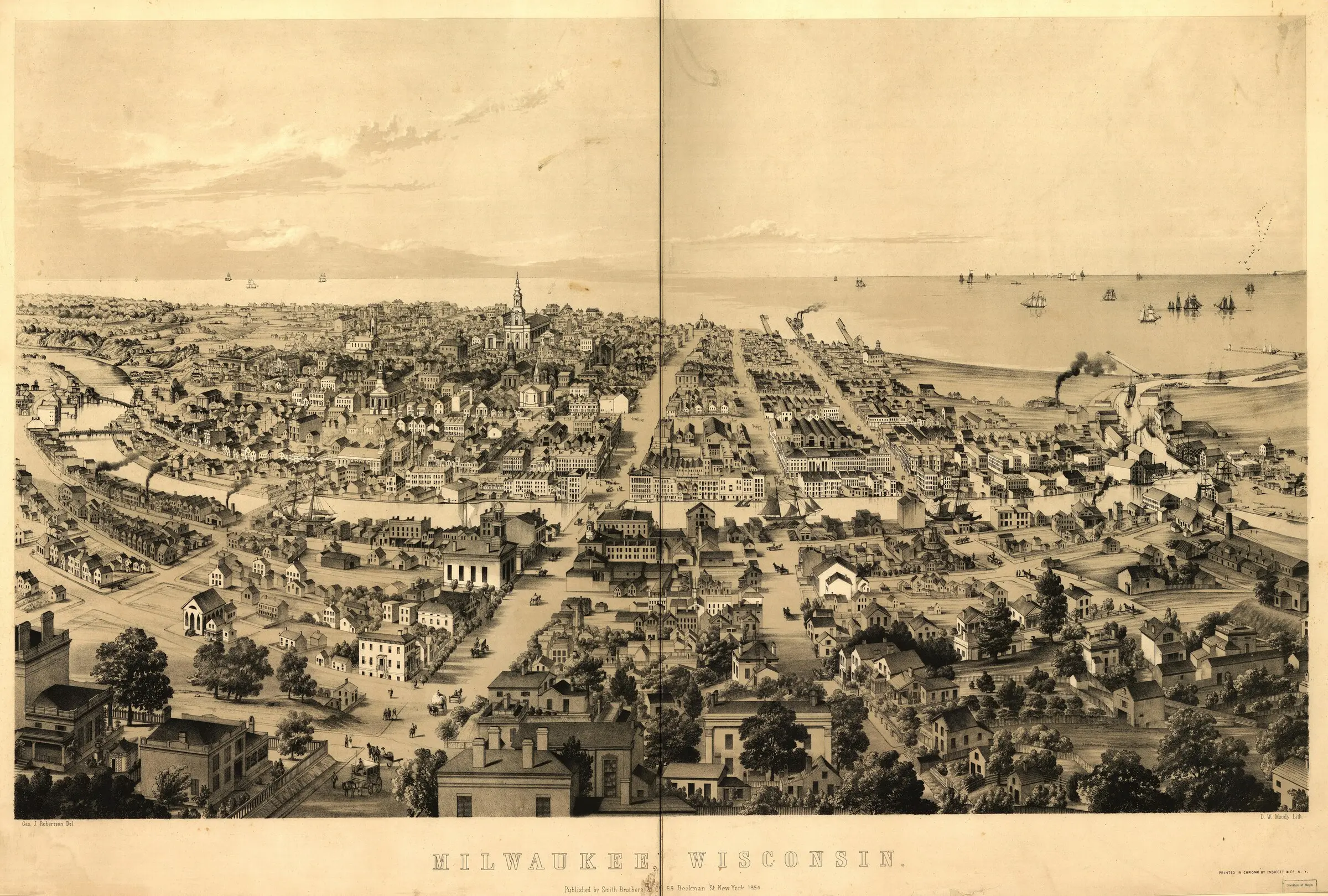
Von Rohr and his group had held their last congregational meeting in Buffalo on September 25, and shortly thereafter about 40 families and von Rohr boarded boats and traveled through three of the Great Lakes to Milwaukee. Milwaukee had a population of about 5,000 people, so temporary housing and necessary supplies could easily be obtained there. We know surprisingly little about the exact date of departure, as well as the journey itself, from von Rohr.
The trip to Milwaukee by ship took about nine days. When ships arrived at Milwaukee they had to anchor out in the lake and transfer their passengers to smaller vessels to reach shore, or to travel up the Milwaukee River as far as Chestnut Street (Juneau Ave.) to where Byron Kilbourn’s settlement, Kilbourntown, was located on the west side of the river. The tired passengers are believed to have disembarked from their long journey about October 4.
Meanwhile, Rev. Grabau arrived in Buffalo on October 4 and conducted his first church service on October 5. Grabau approved of the plans that had been made, and on October 10, he sent off a letter to von Rohr saying that they expected to follow to Wisconsin with his congregation the following spring. This was not to be, however. Many Germans were already in the Buffalo area, and the congregation grew at an astonishing rate. By 1843, the church had 1,500 souls. Even in the first few months they had to move several times in order to find larger quarters for their church services. Then they had the bad luck that the building they had been using burned down, and the congregation had no funds with which to build their own building. At that precise time, a stranger arrived with $300 as a gift from the people of England, who had carried out their promise to help the Germans get started in America. Land was bought in February of 1840, and the new church was dedicated on June 7. It is ironic that on that very day, King Friedrich Wilhelm of Prussia, that resolute enemy of the Old Lutherans, died.